

Latest Books
Climate Fault Lines: The New Political Economy of a Warming World by Alexander F. Gazmararian and Helen V. Milner
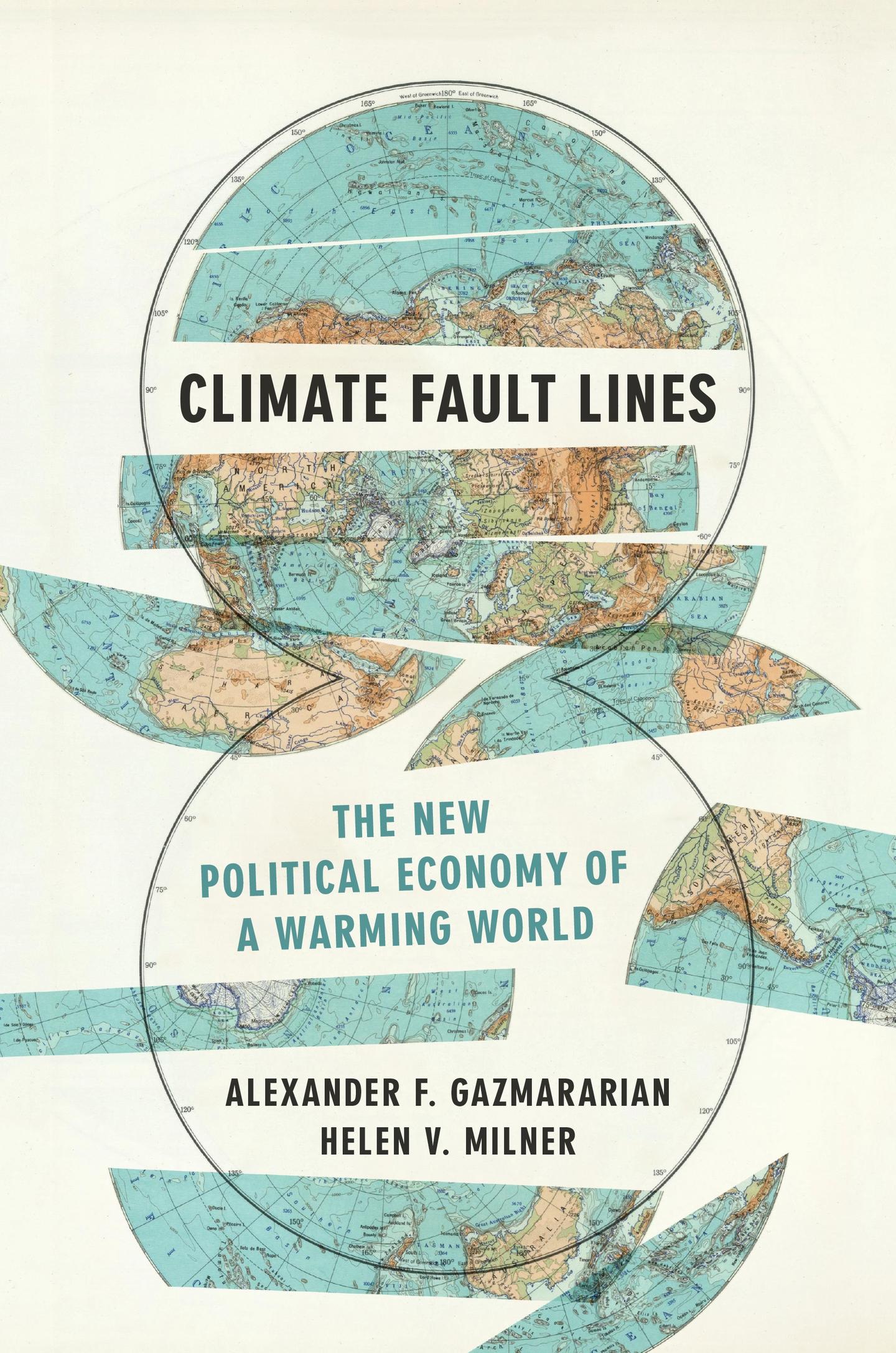
Climate Fault Lines explores how climate change is affecting politics today and what our future holds in a warmer world. It places global warming’s physical perils at the heart of climate politics, unlike theories focused on collective action or interest group resistance. The core claim is that climate change’s unequal effects—a fault line cutting across existing social, economic, and political divides—will produce diverging political responses as the climate changes. People, businesses, and governments on the more vulnerable side of the fault line are most motivated to address climate change. This view departs from prevailing wisdom, such as the idea that Northern European states are climate leaders whereas developing nations are free riders. Above the fault line, when climate policy advances, it’s not because these regions face the greatest danger, but because it delivers cleaner air, economic gains, or greater energy security. Below the fault line, intensifying damage is what forces political action.The book traces how these fault lines are emerging in domestic and international politics. It brings together models from geosciences and economics with diverse data on the public, businesses, cities, and countries. As warming accelerates, people and businesses with the most to lose are mobilizing, reshaping the incentives and policies of local and national governments. The result is growing divergence across the fault line. The world is not in the same boat: unequal harm, not shared vulnerability, increasingly shapes climate politics.
Helen V. Milner is the B.C. Forbes Professor of Politics and International Affairs at Princeton University, and was the founding director of the Niehaus Center for Globalization and Governance at Princeton's School of Public and International Affairs from 2004 through 2026. She was the chair of the Department of Politics from 2005 to 2011. She was president of the International Studies Association (ISA) for the 2020-2021 term and was president of the International Political Science Association (IPSA) from 2012-14. She is a member of the National Academy of Sciences, the American Academy of Arts and Sciences, and the Council on Foreign Relations. She has written extensively on issues related to international and comparative political economy, the connections between domestic politics and foreign policy, and the impact of globalization on domestic politics. She works on topics related to globalization and development, such as the political economy of foreign aid, the "digital divide" and the global diffusion of the internet, the resource curse and non-tax revenues, and the relationship between globalization and democracy, in Africa and the Middle East. She was a fellow in 2021-2022 at the Center for Advanced Study in the Behavioral Sciences at Stanford University. She is currently working on a book about globalization's challenges to democracy, and just published a recent book about the politics of climate change.
Some of her writings include Resisting Protectionism (1988), Interests, Institutions and Information: Domestic Politics and International Relations (Print) (1997) (ebook link), Votes, Vetoes, and the Political Economy of International Trade Agreements (2012), The Political Economy of Economic Regionalism (1997), and Internationalization and Domestic Politics (1996). Her book Sailing the Water’s Edge: Domestic Politics and American Foreign Policy, coauthored with Dustin Tingley (Princeton University Press, 2015), won the 2016 Gladys M. Kammerer Award for the best book published in the field of U.S. national policy. You can read more about the book in recent reviews published in Harvard Magazine, Perspectives on Politics, Governance, H-Diplo/H-Net Reviews, the New England Journal of Political Science, and Passport. Her most recent book is Climate Fault Lines: The New Political Economy of a Warming World, coauthored with Alexander F. Gazmararian, which is forthcoming from Princeton University Press in September 2026.